Siar agus Aniar 12
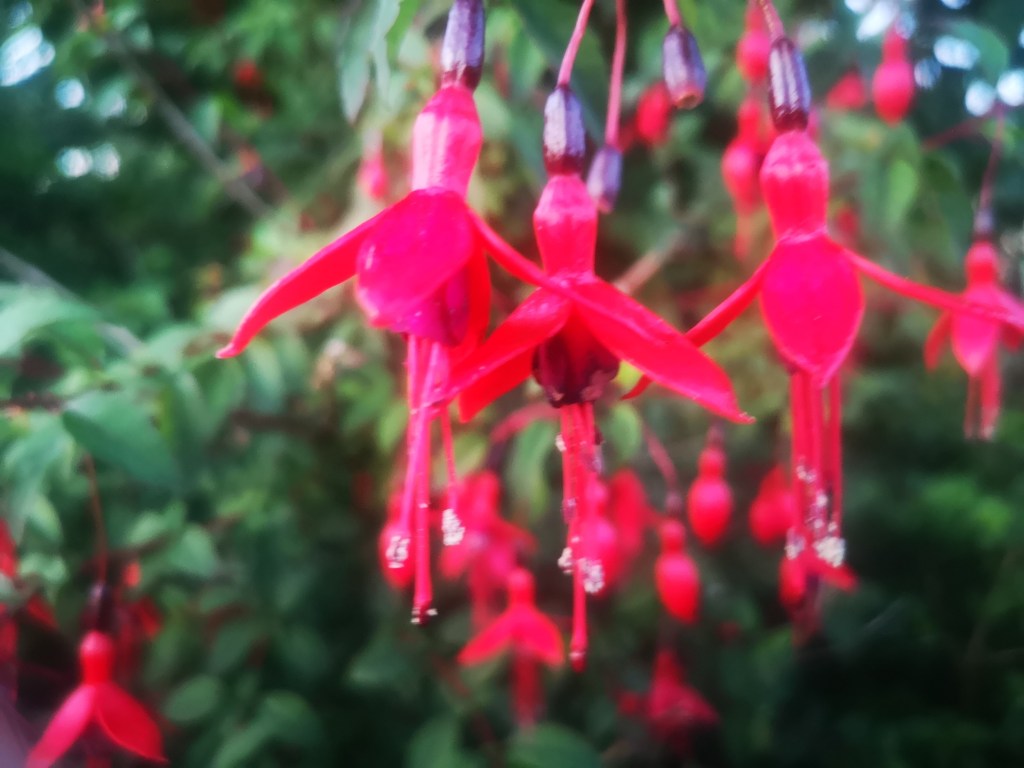
Deora Dé is the Irish name for the fuchsia. This plant was introduced into Ireland as a hedging material and now has naturalized. It is considered an invasive non-native species. It outcompetes native plants in hedgerows. These hedges are significant habitat in Ireland because of the loss of most of its native deciduous forests due to logging and farming. Fuchsia magellanica was introduced from South America. The plant is out of control in much of western Ireland.
Deora Dé means the Tears of God.
The fuchsia has been in full glorious flower for about 1 month. Despite their menace to indigenous species and my knowledge of ecology, I cannot help but admire these flowers. It is a non-stop floral display. To my Nova Scotian eyes, it is tropical and exotic. Seeing it growing perennially outdoors makes mé feel like I am in an exotic country. I am. I am in Ireland.
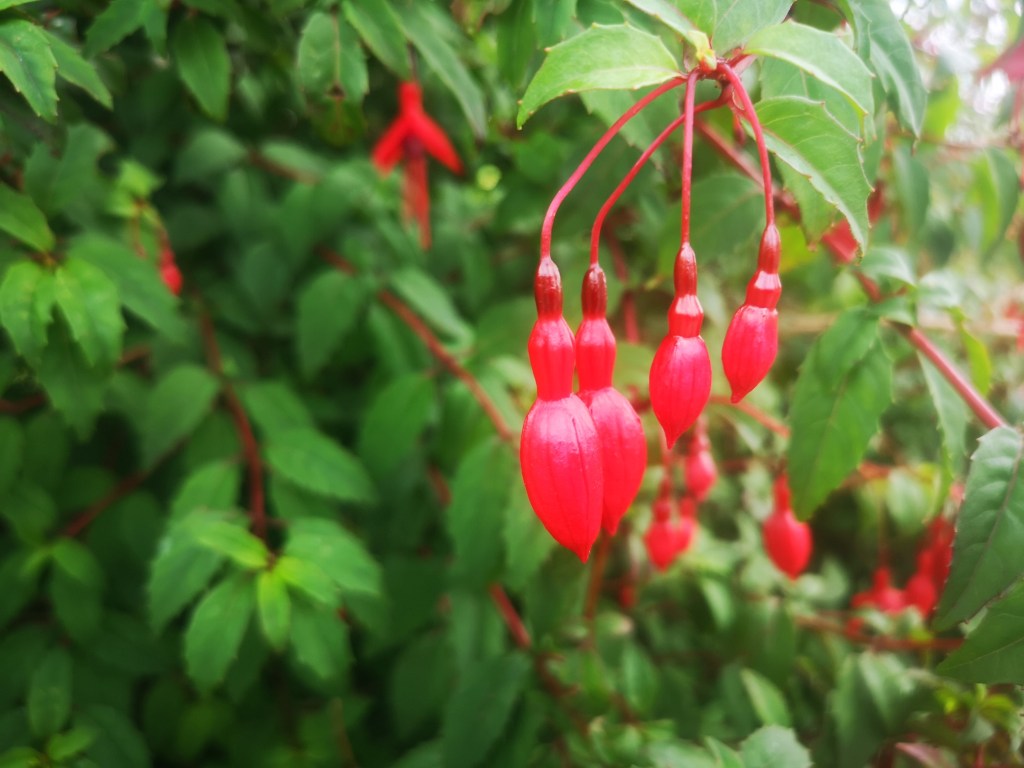
If you open up a new flower, then shake it above the back of your hand, one precious drop of nectar, one sweet tear from your god, will fall.
Deora Dé, le Nigel McLoughlin
“See them?”, she said
and pointed to a yellow
flower blotched with red
“They grew below Christ’s cross.
And see…..”, she said, pointing
to each stain, “the seven
drops of blood.”
“See them?”, she said
pointing to the unopened
fuchsia earrings in the hedge.
She lifted one and nipped
and broke it where the flower
meets the pod and prising the top
end: “Taste!” she said.
A single drop
of nectar fell on the end
of my tongue, surprising
me with sweetness.
“When God cries,” she said
“His tears are sweet
and red.”
I picked an opened version
and did the same.
“See them?”, I said
“Them’s little ballerinas
red skirts, red tights
and little purple knickers.”
I giggled, twisting each dancer
into a turn and turn on a green
backdrop – six pleated
blurs on the stage of a wall.
“You’ll never make a priest”,
was all she said.
Cranndacht, le Louis de Paor
Chuir sí crann caorthainn
sa ghairdín inniu
chuimil a préamhacha
sular neadaigh i bpoll
méara chomh slim
le duilliúr an chrainn
a roghnaigh sí
dem bhuíochas.
Fiúise, ar ndóigh,
a bhí uaimse,
cloigíní fola,
deora Dé.
Is fada léi, a deir sí,
go bhfásfaidh an crann
go dtí an fhuinneog i mbarr an tí
mar a gcodlaíonn sí,
smearadh cré
ar a lámha leonta cailín
is iníon rí Gréige ag siúl
na hallaí bána laistiar dá súil.
Tá rian fola
ar stoc an chrainn
ina diaidh
nach féidir
le máthair na báistí
a ghlanadh ná a leigheas
Nuair a éiríonn an fhuil
i ngéaga an chaorthainn
dem bhuíochas, braithim
an chré ag análú go trom
sa seomra codlata in aice liom.
Go domhain san oíche
ionam féin, goileann Dia
racht fiúisí os íseal;
ní féidir a thocht a mhaolú.
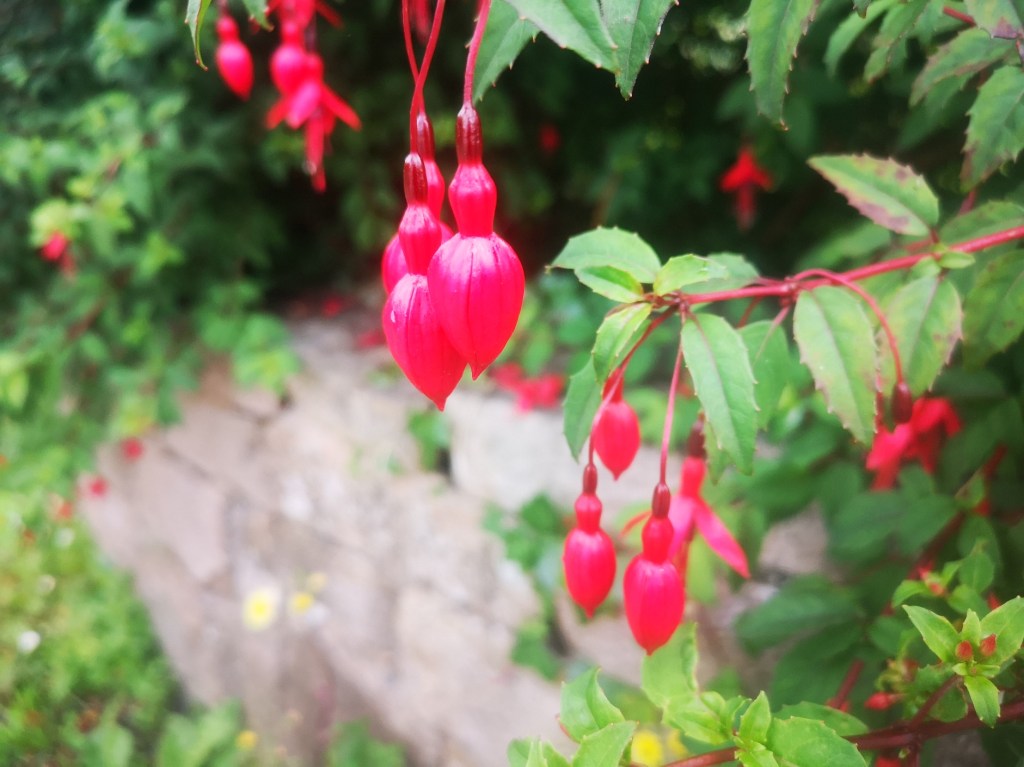
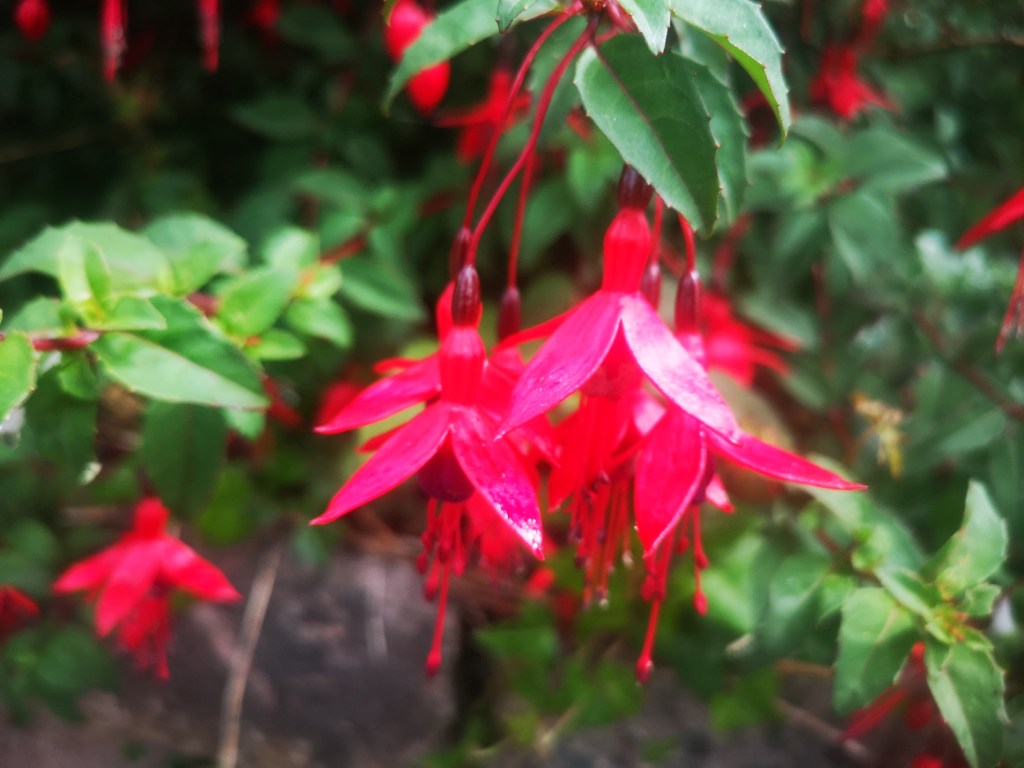
The end of this chapter is coming. I leave Ireland in a couple of days. I am surprised by the sadness. I have never felt sad to leave before. The weeks have flown by. When I arrived the fuchsia had not started flowering. They were invisible along the bóthríní. Unexperienced and unobserved part of my walks. I remember, at the beginning of Bealtaine, when I saw the first flowers starting and suddenly the world was full of the deora dé. Every day, I walked the roads of An Cheathrú Rua and watched the flowers progress.
I measure time by observing the unfolding of the seasons. What is flowering? Spring turned to summer while I was in the Gaeltacht. A quarter turn of the wheel of the year. It seems I learnt more than just a cúpla focal.
 Cumann an Ghleanna
Hi Paul
I can’t believe you only have “a couple of days” left on your trip.
I have thoroughly enjoyed your anecdotes, observations and photos of your trip.
Thanks so much!
Mike Donnelly
Get Outlook for Androidhttps://aka.ms/AAb9ysg
LikeLiked by 1 person
Beautiful.
LikeLike
Paul, I believe that you too have flowered with the deora dé this spring turned to summer!
LikeLiked by 1 person
Enjoy the days left there. Summer is here and if you feel lonely for Ireland, you can visit the hanging fucshia on the deck.
LikeLiked by 1 person